

2026 Day 3 - More nodule talk and an ammonite's mouthparts
/by Finch Neville
In Zoë's temporary absence, the task of writing these daily reports has fallen to me, Finch Neville. As an undergraduate palaeontologist at the University of Portsmouth, I think this site is absolutely thrilling, and it provides me with extremely useful experience as I am surrounded by experts in their fields. When not searching for fossils along the Hampshire coast (or attending lectures, naturally), I am a visitor assistant at the Museum in the Park, where some of the last dig's finds have previously been displayed.
Digging began earlier today due to predictions of even hotter weather later in the afternoon. The cooler conditions proved serendipitous, as there was an initial burst of discoveries - namely some well preserved fish skulls and ammonites.Two fish skulls were discovered in the clay by Max Dereme, a mollusc expert, to great excitement by the team.
As I got onto the site after the morning briefing, Mark Kemp was continuing his streak of excellent finds, having unearthed a Dapedium - a deep bodied fish with rhomboid scales. Unfortunately, the nodule containing the fossil had fragmented, but it was the work of half an hour to collect most of the pieces by sifting through the spoil.
The excavator, despite disliking the heat as much as the rest of us, began to form a new trench in the field behind the existing site, which will be explored later on. With the main site not being extended for most of the day, there was ample opportunity to search deeper into the bed manually.
The process by which fresh nodules are uncovered is a complex but rewarding one, often involving several people. Using a pitchfork, or a mattock if the ground is particularly compacted, one palaeontologist probes carefully, feeling for the telltale resistance of a nodule. Once a nodule is located, a crew of two or three - suitably armed with trowels and hammers - remove the top layer of earth and excavate around the nodule. This allows its size, shape, and orientation to be determined. Following an assessment of the aforementioned characteristics, a mattock or crowbar is inserted underneath the nodule and it is carefully levered out, ready now to be split and have its prehistoric contents revealed. Smaller nodules can often be located and removed by a single person.
Throughout the morning, nodules were found containing ammonites and the bones and scales of small fish. Many deathbeds, planes containing an eclectic mix of disarticulated fish remains, bivalves, ammonites, were also discovered.
After a long and pleasant lunch break to escape the sun at its highest, (although not its hottest, which occurs around five o'clock, when it beats down upon the dig site at a low enough angle that the gazebos can provide little shade), a smaller team returned to continue excavations. The best find was an ammonite aptychus, which in life would have been a component of the cephalopod's mouthparts and potentially aided in blocking the entrance to their shell when under attack. This fossil was exquisitely preserved and had a similarly excellent counterpart (the impression of the fossil on the opposing part of the nodule).
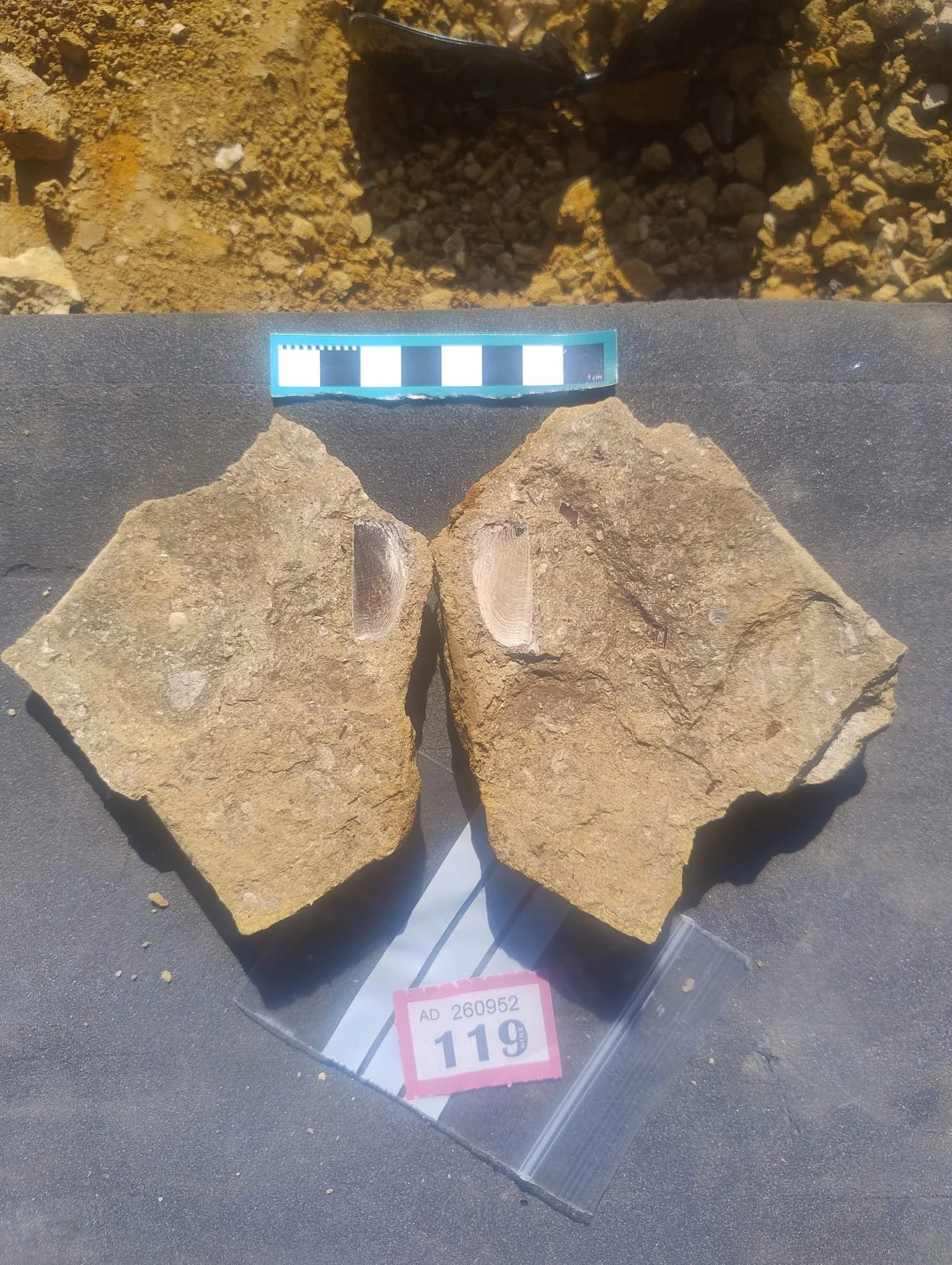
ammonite aptychus discovered on day 3
Even the most ardent of palaeontologists cannot dig through dense clay in the stifling grip of the English summer sun without tiring, and by six the campsite was full once again. The Rest, a café at the farm, was opened for us in the evening and was soon busy - after that long in the field, everyone deserved a cool drink in a refreshingly air-conditioned room.
Hoping to beat the worst of the heat - and possibly find a fish or two - I am turning in early tonight so I can be up for six. This dig site is fantastically rich in high quality specimens, and I can only guess at what will be discovered tomorrow. Stay tuned...

